
Birther of a nation

The hardest part of returning home is not actually driving through East New York; it’s turning on cable news and seeing what new stupidity grips the land. I have been watching news through the international filter the last few weeks, in Amsterdam and Prague: BBC News and CNN International. CNNI is to US CNN what good espresso is to Maxwell House coffee — though they also read viewer email, which is every bit as dull-witted as the stuff you’ll hear in the states. 

But you miss all the really appalling stuff. Of course we heard about the arrest of, and subsequent commentary by Obama and others about, Henry Louis Gates — though what’s this “Skip” shit? When did he go from distinguished Harvard professor to a drummer in a California surf band? That seems one of those telling moments when we remind ourselves, and in this case the world, that we are not really one nation, or certainly don’t all see things the same way or come from the same experiences. When we left the nomination of Sonia Sotomayor was hinging on the same sorts of issues, with Republicans saying, How dare you say your background might influence your actions!

But we missed the seemingly exponential growth of the “birther” movement: those people on the right that don’t necessarily believe Obama was born in the US. And it was only watching MSNBC last night that I saw the list of GOP congressmen who won’t say they believe the president is a US citizen, abetted by people in the media like CNN’s own Lou Dobbs

I can’t think of an exact correlative in political history. Some might say those on the left who insisted on the illegitimacy of Bush’s election, but they didn’t get much traction in the mainstream media, and when they raised their heads post 9.11 (and then after the second election) they were routinely dismissed. It was the sort of sour-grapes reaction a liberal would reach for at the end of an argument, as a sort of parting shot. It was not elevated to a national movement, complete with legislation demanding future presidents show proof of citizenship. 

To me it’s more like the anti-semites who called FDR Rosenfeld; he wasn’t Jewish, of course, but you couldn’t prove that by them. Like Holocaust deniers and that guy who Buzz Aldrin punched for saying he didn’t walk on the moon, these birthers don’t need logic or truth on their side. All they need is a smidgen of suspicion and a ton of resentment and suddenly “alien” can mean all kinds of things. It could mean you’re a brother from another planet, which was my old nickname for Obama, or just another black man trying to break into a house you already own. 
And then we came to the end

If the Anne Frank House is a fitting refutation, or logical conclusion, of the goal for a Jewish museum that Hitler envisioned (see note below), he would have been disappointed in the turnout. Every day crowdes queue up from the time the museum opens to past ten pm, when it is strangely light out still. They stand in the rain for a chance to feel the pain, the shame we must share as humans.

I know: you may have lost relatives in the Holocaust, or may have fathers who fought in the war, as did mine. But the history is bleak: the news of the death camps was everywhere (including Reader’s Digest!), and stories of the Nazis rounding up Jews was not enough to get some people involved. And that is the collective shame.

The good people of Amsterdam, some of them anyway, formed anti-fascist groups as early as 1933, and welcomed the first German refugees with open arms. Many were artists, intellectuals and performers; Anne Frank’s father made jam, which is a form or art where I come from. After the Nazis invaded many resisted (see the Black Book) and gave aid to those fleeing persecution.  Most of the people helping to hide the Franks were rounded up, too.

There is not a lot of hoopla here: no guided tour, no audio guide. You move from room to room, most of them as bare as the Nazis left them, informed by bare-bones text and excerpts from Anne’s diary of what happened. There are videos and some first-person accounts as you move up the stairs and to the last rooms, filled with reproductions of the clips from movie magazines she had on her bedroom wall, followed by photos of the camps themselves.

The last room features a video of her father, who survived to oversee the museum’s opening. He speaks of the surprise he felt at first reading her diary: what a serious girl! he marvels. What deep thoughts she kept hidden and he wept to recall how little he really knew his own daughter.

Back on the street the tourists kept coming. I recalled a reading William Gass gave at Eugene Lang College a few years ago. The then head of the writing program asked him about the moral force of fiction, positing the idea that if Hitler had read Anne Frank’s diary, he could never have gone forward with the Holocaust. Gass (good name!) was quite dismissive of the idea, and practically laughed like a Santa. Of course he could have read it and killed them all.

Next question.

Death takes a holiday

Going from Amsterdam to Prague and back, it’s hard to avoid the history of the Holocaust. Maybe it’s because the house where were staying is just two blocks from the Anne Frank House. Or maybe it’s just that the history of the Jews in Europe, the diaspora that Hitler tried to end, is so thick beneath your feet. Like blood on the tracks.

I had always wanted to go to Prague, or at least since I was 13 during the Prague Spring and Life magazine was filled with pictures of Czech hippies with their fingers held aloft in a peace signs. And then reading Kundera all those years later, and even seeing Stoppard’s Rock ‘n Roll, made me romanticize the place. It became a cool destination after the Velvet Revolution put Havel in the driver’s seat, if only for a while.

The reality was a little colder and darker than my Alan Furst-drenched fantasy. Turns out the movie of The Unbearable Lightness of Being, for instance, was shot elsewhere and remans a source of comedy for Prague’s citizens. Renata, the woman we had dinner with the first night there, told me that Kundera himself was somewhat controversial. He still lived in France, all these years later, and even wrote in French. His books had to be translated into his native language.

In the Czech Republic, nothing is black and white,  she told me as I ate my duck and sauerkraut. Her mother’s family was killed in the Holocaust. Her father was later jailed by the Communists. She visited him each month in prison for ten years and he encouraged her to join the Party so that she might someday work as a journalist, as she hoped to. But she was allowed into the university in 1968 because of her father’s reputation, not in spite of it: The academics all admired him for going to jail. And a  year after she arrived, the people who accepted her were out of power at the university. If I had gone a year before or a year after, I would not have gotten in, she said.

Josefov, the site of the former Jewish Ghetto, is a small part of the old city; it was walled off from the rest of Prague for hundreds of years to keep the Jewish population out — and sometimes to protect them from the Christians’ ritual pogroms and blood libels. When the Nazis captured the city they forced the Jews to reside there again, while looting their art and holding it in the neighborhood’s synagogues. Today those buildings house some of that art — and the names of the tens of thousands of Czech Jews killed in the camps.

Hitler wanted to make a museum of Jewish culture right there himself: That’s right, after obliterating an entire people he thought it would be nice to make a little memorial to them. (This is one of the many reasons Hitler still holds the gold medal in evil and why comparing any other despot or madman to him is so unfair.) He didn’t have chance to see his museum.

Instead we have the Anne Frank House.

Little people love Bacon

I’ve been entertaining my brother and his family in New York for the last few days, which is kind of redundant: the city is pretty entertaining on its own. The weather has been strangely cooperative with days more typical of May than July and no rain, something you could not say for the entire month of June. 

Among the stranger sights we’ve seen in our travels was a sign on the door of Brooklyn Ice Cream Factory saying they welcomed little people. That seemed to me like putting a sign on a topless bar saying We Welcome Men until I noticed the camera crew filming what appeared to be a dancing Benjamin Button on the ferry landing, and then a gaggle of can-we-still-call-them dwarves confirmed my suspicion: The Little People of America were having a conference nearby.

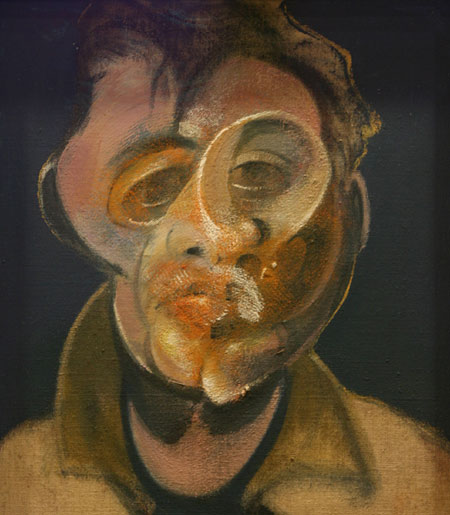
Almost as strange was discovering, upon our visit to the Metropolitan Museum, that the Francis Bacon retrospective was a hit: an out-the-door, through-the-window, fun for all ages kind of show, with little kids in matching YMCA shirts being paraded past his tortured portraits as if they were the Liberty Bell. Is Bacon ready for his Van Gogh close up? I can’t imagine his painful-to-behold triptychs adorning coffee mugs and shower curtains, nor Don McLean writing a song about Pope Innocent X — but the Bacon T-shirts were moving. Rather than a reproduction of his art work they were adorned with one of the Irish misanthrope’s beloved quotes: “Champagne for my real friends, real pain for my sham friends.”

Amazing show, if you haven’t seen it. In my facile understanding of his biography, I always kind of wondered if maybe his work would not have been so hallucinogenically dark had he taken fewer hallucinogens and not drank so much. But seeing the progression, from the earliest show which purblind art critics misunderstood to the famously twisted self-portraits, I got a better appreciation of the consistent and undeniable dark vision — on informed by war and homophobia and loss and (yes) substance abuse. The portrait of his lover George Dyer, who took his own life, is particularly devastating: a shade unlocks a hotel room door and simultaneously disappears before your eyes…

My teenage niece Ali loved the show too. You don’t have to explain dark and twisted to anyone in the throes of adolescence, perpetual or not.  

Sarah Palin, Dadaist

Pundits have been saying for a while that the GOP needed to reinvent itself and yesterday Governor Palin put herself in the vanguard of the cause with a bold and surrealistic speech that owed more to the Situationists than the RNC. Sure, you can argue that Mark Sanford got their first with his rambling guess-what-I’m-talking-about confessional, but yesterday Palin set the bar.

Or, as she might put it, she knew when to pass the bar to victory. 

Now this kind of radical career rehab is not for the faint of heart; Britney Spears had to shave her head in public and go through a kind of painful chrysalis that few other conservatives could endure. (You may recall her big plug for Bush and the Iraq war, captured for all time in Michael Moore’s Farenheit 911.) Dangerous, yes, but now she is back on top of the charts and every bit the model mom she was before her Dada period. 

Truth to tell, Palin owes a nod to William Burroughs and Brion Gysin too. What other than their celebrated cut-up technique can explain quotes like this: “A good point guard, here’s what she does: She drives through a full court press, protecting the ball, keeping her head up, because she needs to keep her eye on the basket. And… she knows exactly when to pass the ball, so that the team can win. And that is what I’m doing. Keeping our eye on the ball. That represents sound priorities, remember, they include energy independence, and smaller government, and national security and freedom… and I know when it’s time to pass the ball for victory.”

Wow. If you fall into the trap of logic — wondering, for instance, who the guard is, let alone what constitutes victory in this particular game, and how the hell energy independence and freedom got on the court — well, you’re just asking the wrong questions. 

An act of insanity? You wish. We are the ball here and it is us getting played. Her career as a politician may be in jeopardy, though it is hard to tell these days just what you have to do to get permanently bounced from public office (retiring in disgrace is so 20th century!). But her career as a performance artist and world-class surrealist is assured. 

For Alaskans. And for Americans.